(Sail : September 13-29) (South Africa : September 29-October 17)
DISCLAIMER: This is a VERY LONG post, covering over one month of time and includes OVER ONE HUNDRED PICTURES!
I spent a year in South Africa when I was 18 years old. I fell in love with the country. I had always wanted to share this place with Joe. We always planned on someday…Someday we would visit the country together and see the beautiful places.
And this year, God has blessed us tremendously by making our someday this day. He fulfilled a dream of mine, and I am so awed by Him.
We joined this ship with no hope or expectation that we would ever be in South Africa, so God has surprised us. You can never out-give God.
In preparation for the sail, the ship raised the South African flag:

We left Las Palmas on September 13. We sailed for 17 days. Most of the sail was uneventful. The following are a collection of pictures taken the first two weeks of the sail:


This next one was digitally enhanced by Joe, and it is oh-so-pretty:

There was a rainbow playing peekaboo, shimmering in and out of vision. Out of two dozen photos, this is the only one that managed to capture the elusive rainbow:

Here are Joe's babies, all covered up for the sail:

The sound of the ocean was very soothing.

However, the last three days were rough. The ship rolled 21-23 degrees to the side. This is a lot for our ship. This is a lesser roll, but still sprayed the entire bow:


The larger rolls wreaked havoc. I was working in the galley on the first day of rough seas, Friday, September 26. It was brutal. In the afternoon, many of our shelves emptied their contents onto the floor. The fridges were a mess. We were making beef ribs, and just getting the dozen trays out of the oven required four people working together. Once a roll started, all seven of us raced to brace the most precarious of dishes or the rolling trolleys. Despite having brakes set, the trolleys rolled like crazy, banging into whatever happened to be in its path. I acquired several bruises. But we have learned from this. For future sails, some dishes will be pre-made and frozen so that no further injuries occur.
Finally, land is spotted. Notice the outline of land in the distance, behind the ship on the horizon:

The Waterfront is an area within Cape Town where the mall and many other amenities are clustered. Pulling into the area, we saw some gorgeous views.


How awesome would it be to get your exercise by kayaking with this view to inspire you!

And, of course, I could not get by without getting a few shots of my favorite subject:


Here is the actual Waterfront. The blue-roofed building is the Table Bay Hotel who was very generous to us during our stay. We had a prime berthing spot right behind the hotel:


We first docked at a berth near the custom and immigration office before moving onto our home berth. The process for landing is the same for leaving only in reverse. A pilot comes onboard to guide the ship into the dockyard. As we near our berth, two tugboats arrive to guide us into place. Then the lines are tied. Finally, the gangway is lowered.


The ship was cleared in the late afternoon, however the crew, as individuals, were not yet processed through immigration. That evening, the ship moved to its new berth right outside Table Bay Hotel and a 2-minute walk to the Victoria Wharf mall.


On the dock waiting were some special people, including the last two of our Gateway members, Mike and Sue! Finally, the whole family is together again! There were about 15 people cheering as we slowly glided into place. And, wow, did they make a loud, joyful noise!


I noticed a few quirky things on our way in. First, there was a seal which is not uncommon to the Waterfront. However, this one was perched inside a tire that act as a buffer between a ship and the dock. This little guy was fearless, never budging though we parked right next to him.

Onboard, we had a dance party going. We were so loud and boisterous, even the dock hands joined in the fun!


As stated earlier, the crew had not yet passed through customs so we could not go off ship that night. The next morning, September 30, was MY BIRTHDAY! My friends onboard were generous and started off my day with such joy.


All 200+ crew were shuttled, in groups, to the immigration office where we were officially cleared to enter the country (i.e. leave the ship). Just in time for a birthday walk! I took a few pictures of the afternoon. Five of us escaped the confines of the ship. We were quite eager. After all, we had been onboard for 18 days!


Here is the Jolly Roger, available for sightseeing tours and Pirate Parties!

Here is some local flowers, though I am not sure of the name.


We took a stroll outside the Waterfront, down Long Street, to Green Market Square which is a place for local vendors to sell their wares. It offers many African novelties, including paintings, carvings, clothing, and much, much more! I indulged and purchased two carvings.


We did stop at the Waterfront Food Market on the way home. I had a nice vanilla gelato. I also purchased some Ostrich and Kudu biltong for Joe. Biltong is the South African version of beef jerky, but the biltong is more highly exalted than beef jerky. Not only are there a large variety of meat types, but also a variety of spices applied to each meat. There are so many choices! And no, I did not try any.
Joe did take me out for dinner for my birthday. We ate at Spur and had our first good hamburger since we left Illinois! Unfortunately, I did not get any pictures of us at dinner. We simply enjoyed the evening together; dinner, dessert, and an after-dinner drink.
The next few days I worked. But, Joe and I had a four-day weekend, Friday October 3 through Monday, October 6. I planned a short two-night getaway in Simon's Town, which is about one hour southeast from Cape Town. Friday, we just relaxed around the Waterfront, enjoying some pizza and gelato. Saturday, we picked up a car from Avis (yes, Avis is in South Africa). Unfortunately, because it was a holiday week, we had a limited choice of vehicles. We rented a small car with manual transmission. I do not drive stick shift, so Joe had to play chauffeur all weekend. But, since the scenery was beautiful, I did not feel so bad for him.


We stayed at Boulders Beach Lodge in Simon's Town. The main attraction are the penguins. Yes, I said PENGUINS! Simon's Town is home to a large colony of African penguins. Previously named the Jackass Penguin due to their braying sounds, the African Penguin lives in southwest Africa. Boulders Beach is home to about 2,200 penguins. Our lodge has a penguin home on the premises. Two penguins lived there, but at night they would invite all their friends over for a party - it got quite loud!


We hung out at the lodge during Saturday evening, and spent all day Sunday penguin watching. The morning began with a visit to Boulders Beach.


We climbed over some boulders and tunneled between others. We spotted one penguin hiding in a small crevice.


We finished our morning at Boulder Beach by getting our feet wet.


And, of course, a little nap in the sun:

Next, we took a stroll along the penguins path. The path has two locations that stop close by the penguins, very much like a scenic overlook point on hiking paths.


We also encountered an unusual animal amidst the penguins' refuge. Fortunately, we also encountered a very knowledgable South African man who told us what we encountered: the hyrax. The hyrax is most commonly found on Table Mountain which is one South African attraction I did not get to see before we left.


After a delightful few hours chasing penguins, we headed to Fish Hoek, a city about 15 minutes north of Simon's Town. I had been there before. I wanted to share this place with Joe. However, it was not quite as I remember it. It was windier than I remembered. The sand is very fine, like flour. The sand was blown everywhere! Including in our eyes. But, still, we sat on the beach for about two hours just enjoying the sunshine and the country. The other change I noticed was the many more interracial socialization occurring than I saw years ago. This gives me great hope for the future of the country.
South Africa has a very violent and turbulent history. The Apartheid ended in 1994. If you do not know what Apartheid is, please look it up. When I was there in 2001, it was less than a decade after the end of Apartheid. Racism was still evident. But, seeing those kids of different races playing together on the beach was awesome.
Monday we headed home. We had to share the highway with a family of baboons. Literally, the baboons were just strolling down the highway.


We passed within two feet of this big guy. I took this from my passenger side window.

I worked the next two days and only had one day off before I worked the following weekend. We, of course, when out for gelato often. After work on Saturday, October 11, we did go out for gelato with friends and then for a drink.

Over this same weekend, the ship hosted public tours. This was just one part of the public relations strategy developed for our time in South Africa. The mall played one of our videos over the main auditorium screen for free. We also brought in one of the South African 4x4s and set up a display inside the mall. During these public tours, groups of about 15 people were escorted through the ship by staff volunteers. A total of 4,211 people passed through the ship over three days. This was an incredible opportunity for the public and for Mercy Ships.
I decided to pamper myself in the days before we set sail again, but after my last day in the galley. Monday I shopped and got a wonderful new hairdo. The stylist even straightened my hair. Tuesday, I went to Camelot Spa inside Table Bay Hotel. A friend gave me a gift card to the spa for my birthday. I had a Salt Glow and then a deep tissue massage. It was incredible. The first picture is where I had my full body salt scrub. The second picture is where I had my hour-long deep tissue massage.


I felt so incredible for the next week. (Thank you, Carol, for the generous gift!)
Later that afternoon, October 14, I visited Robben Island. Robben Island is an island off the coast of Cape Town that has been used as a prison, a hospital for outcasts, and a military base. But most often as a prison. Here is a brief history lesson (very brief as the island has a very complicated history):
The Dutch East India Company sent Jan van Riebeeck to what is now South Africa to set up a colony. Van Riebeeck set up the island as a prison for slaves and prisoners of war; those imprisoned on the island were forced to cut stone and burn seashells for lime. Over a hundred years later, the British captured the Cape from the Dutch, and they continued to imprison military and political prisoners along with criminals on the island. The prison was closed in 1846, and a hospital was opened for lepers, the insane, and the chronically ill. Robben Island was the main leper colony in the Cape with over 1,000 inmates. The hospital closed in 1931. In 1936, the island became a military base. In 1959, the island once again became a prison, but this time for political prisoners selected by the Apartheid regime along with common criminals. The political prisoners left the island in 1991, and the prison closed in 1996.
The ferry to the island was a short walk from my ship. I passed over the Swinging Bridge, which is a very cool idea. When a boat needs to pass through the channel, one end swings so that the entire length of the bridge lays on one side of the channel. Here is the bridge swinging back into place:


I also passed by the Clock Tower:

Once at the Nelson Mandela gateway, I boarded a ferry bound for the island. I snapped a few pictures along the way.

Here is a seal waving goodbye as we left:

The seals were also doing backflips, but they were so fast, I never got my camera up in time to catch them mid-air.

Here are some pictures of the island as we came in:


Once on the island, I had a guided tour around the island via bus. Some of my pictures were taken through the bus window, but there are many interesting sites on the island. This slogan greeted us as we docked at the only port in Robben Island:

Here is a map of the island from 1784 when the Dutch still had control of the island:

This church was built in 1841 by prisoners and is now known as the Garrison Church:

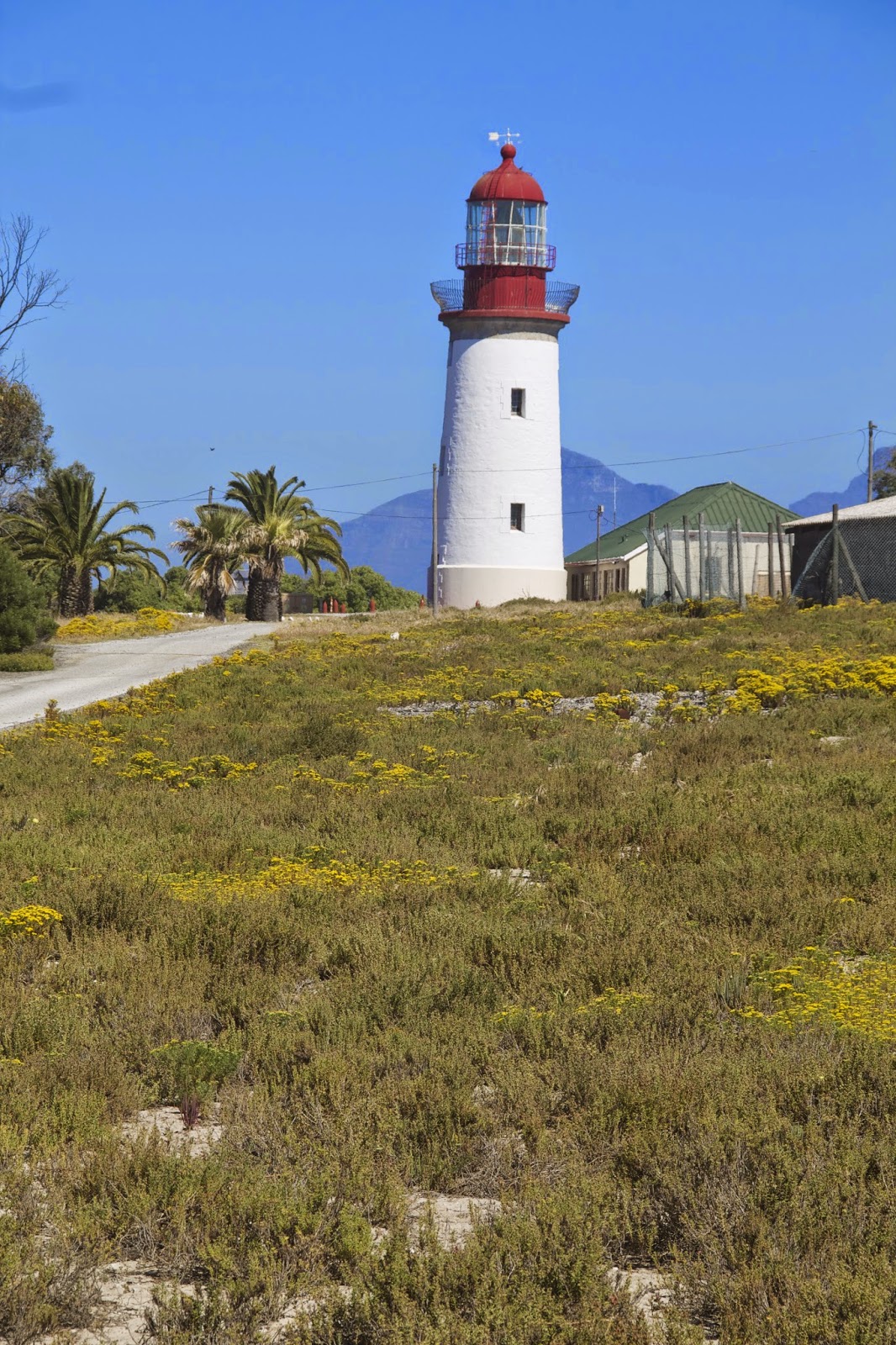
The lighthouse was built in 1864 after a vessel shipwrecked.
This church was built in 1895 by the lepers and is now known as Church of the Good Shepherd:

Next to their church, there is the lepers' graveyard:

Here is the Limestone Quarry. This is where many of the political prisoners were sent for hard labor. The cave was used as the outhouse.


One prisoner received his own house. Robert Sobukwe was the leader of the Pan African Congress. He was considered dangerous, but not in the physical sense. He was very influential among the prisoners. He was not allowed to communicate with other prisoners or guards. He used hand gestures to communicate to the guards. After a few years, his children were allowed to visit him but stayed at a separate bungalow on the island.


The maximum security prison was built in the 1960s by the political prisoners.


Here is a common room within the prison:

Here is the outside of the cells…Mandela's cell is the third room from the left side of the picture, with the window ajar:

Here is a replication of a political prisoner cell:

And there are lots of cells, all lined up down this long hallway:

And oh-no, here I am behind bars:

Remember, all the political prisoners sentenced to the island were black and were referred to as Bantus. They were treated worse than the criminals. Bantus received only shorts, no underwear, to wear. The criminals were given underwear and long pants. Here is a meal plan for those imprisoned. Notice that the Bantus receive less food and absolutely no bread. This changed in the mid-1970s. The political prisoners were treated more equally, at least superficially. They received the same food and uniforms as the criminals. However, the guards and system was still very biased against them.

Their letters to and from the island were scrutinized and edited by guards:

The man giving us the tour through the prison is actually a former prisoner.

Currently, there are about 200 people living on the island. Many inhabitants are former prisoners and a few are former guards. The former prisoners and former guards get along well. The island is now a testament to how democracy and freedom triumphed over oppression and racism. You can find beauty among the ruins of the prison if you just look for it.


I highly recommend visiting the official website for Robben Island. They have a virtual timeline and a virtual tour that are very interesting.
http://www.robben-island.org.za
The trip also provided my largest wildlife encounter to date. I saw the seals on the way to the island. Mid-way through the bus tour, we saw a whale just 20 yards off the coast. Just after leaving the island, I saw a penguin swimming in. Half-way home we saw a pair of dolphins. And, finally, there were more seals to greet us when we returned to the mainland. It was a wildlife extravaganza!
Here's the penguin swimming home:

Wednesday, October 15, I transferred to the Hospital from the galley. About 60 nurses joined the ship over the past few days, so there were a lot of new faces. We started hospital orientation, though we did get the afternoon off - a few last hours in Cape Town. And here, in the mall, I saw an off site:

Yes, that is a goat in a shopping cart in the middle of a mall!
In preparation for leaving the country, we moved back to the immigration and customs dock on October 16. I was very sad to say goodbye to this place, I did not even go outside to say goodbye.

However, a problem was discovered with the main engines. Our departure was delayed. Thank God (literally), the delay was less than 24 hours. As the engineers worked diligently, the rest of the crew once again shuttled over to the immigration office, passports in hand. Even though the repair was completed by evening and the crew all passed through immigration, the higher-ups on the ship decided to wait until the following morning to leave. Weather conditions were less than ideal that night, but the following morning was gorgeous. We headed out for Madagascar October 17.


